A misspelled award title, wrong class year, outdated school logo, or mixed-up officer variation can affect an entire pin order. Finding the problem on the day of an assembly or induction leaves little room to respond.
A reliable school pin order therefore needs more than an attractive design. It needs one clear source of information, careful proof approval, enough time before the event, and an inspection when the shipment arrives. Use the following checklist for academic awards, student council programs, clubs, teacher recognition, class events, and graduation keepsakes.
1. Define the Program and Recipient Group
Write one sentence explaining why the pins are being ordered and who will receive them. For example: recognize honor-roll students, welcome student council officers, thank faculty mentors, identify club members, or give graduates a class keepsake.
This decision controls the layout, wording, quantity, packaging, and presentation. If the list contains unrelated groups with different messages, separate them before requesting artwork. A pin that tries to serve every school program at once often becomes crowded and difficult to distribute correctly.
2. Choose the Established Layout That Fits the Message
The School Pins collection uses established designs rather than unrestricted from-scratch outlines. Match the program to the structure that already gives its most important information a clear place.
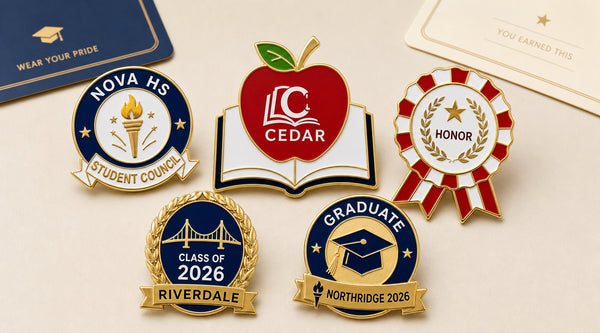
An open book supports academic artwork and a short award ribbon. A rosette emphasizes achievement. A round seal separates a school name, center emblem, and student council label. A scroll provides lines for a club name, motto, and year. Apple-and-book, mortarboard, graduation badge, and laurel-framed class layouts support their corresponding school moments.
Choose the layout for its information hierarchy, not simply because it has the most decorative elements. For a broader comparison, read School Pin Ideas for Students, Clubs, and Academic Awards.
3. Confirm Artwork Authorization and File Accuracy
Identify who at the school can approve use of the logo, crest, mascot, department mark, or initials. Do not rely on an image downloaded from a search result or an unofficial social account. Confirm that the artwork and school name are current.
Supply the clearest approved file available. If the crest or mascot is detailed, identify the symbol that must remain recognizable at pin size and which secondary elements may be simplified. Keep a copy of the source file with the order record.
4. Create an Exact Wording and Variation List
Copy final wording from an approved program document instead of retyping it from memory. Check every award title, school name, class year, club name, council role, and event phrase.
Use a simple variation list with one row for each design. Record:
- Exact center artwork.
- Exact ring, ribbon, banner, or year wording.
- Enamel colors and Gold or Silver finish.
- Quantity.
- Backing.
- Packaging and printed packaging copy.
- Required event or distribution date.
Mark similar words that are easy to confuse, and verify recurring years carefully. A single incorrect letter reproduced across a large order becomes a program-wide problem.
5. Check Quantity by Design
Orders can start at one piece, while quantities of 50 or more generally offer better value. Changing officer titles, award wording, years, colors, or center artwork can create separate versions, so record the quantity needed for each.
Compare pricing for individual versions with a shared design. A small student council may prefer one STUDENT COUNCIL design with officer names and titles on presentation cards, while separate title pins may suit another program.
Include known recipients, reasonable replacements, midyear additions, and any archive or display copies the school actually needs. Avoid creating excessive variations solely to personalize individual names.
6. Select School Colors and Metal Finish
List the approved school colors and indicate where they should appear in the established layout. Prioritize contrast so the center emblem and short wording remain easy to distinguish.
Choose Gold for a warmer outline or Silver for a cooler one. Do not assume the finish automatically communicates a higher or lower award level. If finishes represent different program tiers, document that system in the variation list and apply it consistently.
7. Match the Backing to the Garment or Display
Confirmed options include Rubber Clutch, Metal Butterfly, Deluxe Clutch, Jewelry Clutch, Safety Pin, and Magnet. Select according to how the recipient is expected to wear or display the pin and confirm that the chosen option is listed for the design.
Consider blazers, uniforms, cardigans, lanyards, letterman jackets, presentation cards, and school dress policies. A Magnet avoids a puncture but should be evaluated for fabric thickness and movement. Do not assume one attachment is ideal for every recipient or garment.
8. Decide What Belongs on the Pin and Packaging
Keep the pin focused on one school identity and one concise program message. Put recipient names, full award citations, term dates, event details, and longer thank-you text on packaging.
A Custom Printed Paper Card can explain what the student or staff member accomplished and help organizers label packages. Polybags provide simple separation, while velvet bags and paper, plastic, or velvet boxes can support different presentation plans when listed for the selected design.
Review printed packaging as carefully as the pin. A correct pin attached to the wrong name or role card still creates a distribution problem.
9. Plan Backward From the Event Date
The listed delivery choices cover production and shipping in 7, 10, 20, or 30 business days after proof approval. The timeline does not begin when the committee first discusses the order; it begins after the proof has been approved.
Allow time before approval for artwork collection, internal school review, wording confirmation, and revisions. Also leave a buffer after the expected arrival so the school can count and inspect the order before an assembly, induction, open house, graduation, or staff event.
Treat the 7-day option as a delivery schedule, not as a different customization method. A short schedule should never be used as a reason to skip checking the proof.
10. Review Every Digital Proof
The product information lists a first digital proof within 12 hours and revisions within 7 hours. Assign at least two reviewers with different responsibilities: one familiar with the school's visual identity and one responsible for the recipient list or program wording.
Check the proof for:
- School-name spelling and approved artwork.
- Award, role, club, event, and year wording.
- Logo scale and artwork orientation.
- Readability near the finished pin size.
- Enamel color placement and contrast.
- Gold or Silver finish.
- Backing and packaging selection.
- Quantity for every version.
- Printed card names and text.
Review each variation separately. Do not approve one representative image when other titles, years, colors, or cards have not been checked.

11. Save the Approved Order Record
Keep the final proof, source artwork, variation list, quantities, selected options, delivery choice, and approval date together. Record who approved the school identity and who approved the order details.
This file gives the school a reference if questions arise at delivery. It can also simplify a future reorder without relying on memory or an outdated logo saved in an individual's email.
12. Inspect the Delivered Pins Before Distribution
A correct digital proof does not replace inspection of the finished order. Open the shipment soon after arrival rather than leaving it sealed until the event.
Count each design and compare a selection from every version with the approved proof. Check spelling, year, artwork, finish, enamel placement, attachment, packaging, and printed card text. Look beyond the first piece at the top of the package.
If something does not match, photograph the affected pins and labels, keep the packaging and approved proof, note the quantities involved, and contact the supplier promptly with a clear description. Early inspection gives the school more time to discuss an appropriate response before recipients arrive.
School Pin Order Checklist
- Define the program, recipients, presentation moment, and event date.
- Select the established layout that fits the information.
- Confirm artwork authorization and use the current school identity.
- Prepare exact wording and a separate record for every variation.
- Confirm the quantity and pricing for each design.
- Select school-color enamel areas and Gold or Silver finish.
- Choose a backing based on the garment or display plan.
- Move names and long messages to suitable packaging.
- Plan the schedule from proof approval, not the first inquiry.
- Review every proof for artwork, wording, year, options, and quantity.
- Save the approved proof and complete order record.
- Inspect each delivered version before the distribution date.
Frequently Asked Questions
What information should a school prepare before ordering pins?
Prepare the program purpose, recipient count, event date, authorized artwork, exact wording, school colors, preferred finish, backing, packaging, and a variation list showing the quantity for every design.
How many school pins should we order?
Begin with the confirmed recipient count, then add only the replacements, late additions, or archive copies the program reasonably expects to use. Orders can start at one piece, while quantities of 50 or more generally offer better value. If artwork or wording varies, list the quantity for each version before comparing prices.
What should be checked on a digital proof?
Check spelling, years, authorized artwork, logo scale, text readability, enamel color placement, finish, backing, packaging, printed card copy, quantities, and every design variation. View the artwork enlarged and near its finished size.
When should a school begin planning a pin order?
Work backward from the event using the selected 7-, 10-, 20-, or 30-business-day production-and-shipping timeline after proof approval. Add time for internal artwork approval, revisions, shipment inspection, and an event buffer.
What should we do when the delivered pins do not match the approved proof?
Document the difference with clear photos, identify the affected designs and quantities, preserve the packaging and approved order record, and contact the supplier promptly. Inspecting the shipment early makes this conversation easier to manage before the school event.